
Getting comfortable with being uncomfortable
Some thoughts from six months of marathon training

I’m training for the London marathon this year, which will be my second marathon. I’ve run more than two hundred miles to prepare for it and that’s a lot of time in your own head: this is what I’ve been thinking about.1
I went to school when girls didn’t play football. This is true for most people because for all intents and purposes, girls didn’t play football until pretty recently.2 I hadn’t really given it a second thought because I didn’t want to play football – or hockey, or rugby, or netball, or tennis, although I did quite like lacrosse. It took me almost two years of secondary school to realise that we’d been rotating sports once a term, and also that we’d been taught the rules for each of them. It was a whirlwind of bibs and initials (GA? GS? GK?) and equipment that I had no handle on. As I realised I had friends who loved football as children, who were getting football shirts for Christmas and then getting left out of playground teams and never seeing themselves represented on TV, I felt very sad for them, but I didn’t recognise it as an experience. So for quite a while, when I thought about the women’s football revolution, I thought that girls who wanted to would finally have the chance to love something as equally as the boys around them and know that they could find themselves represented at actual football matches. I thought it was joyful to see ten year olds in football kits on the tube. I thought ‘I wouldn’t have been doing that even if it was as prevalent when I was ten as it is now’. I also don’t doubt that it makes a difference to my worldview that I was at a girls’ school, so actually girls did play football, and liked it! The thing about girls school, is that girls do everything, so you don’t realise how it relates more broadly to what everyone else thinks girls should do.
What I’m learning — and it has taken already having run one marathon to even uncover this — is that because I didn’t play football, rugby, netball or tennis properly, I have no idea what it means to be anything less than comfortable in myself. I have no idea how to get to the very limit of my physical capacity and keep going. I have no idea how to fall over or get injured. It took a long time to learn how to dig deep when I’m physically exhausted, but I also hardly know how to control being too excited. If I lose my breath, I lose my head, if I lose my focus, I lose my head, if it feels too hard, I lose my head. I never learnt how to get uncomfortable.
This is the broader effect of leaving women out of sport — I now realise, perhaps much later than everyone else. Some of them will have missed opportunities to play for their county or to make careers as referees or pundits. But far more of them will never have run so fast that their lungs burn, and learnt from the experience that you don’t die. The first bit of discomfort doesn’t kill you. Your legs don’t snap in half the first time one of your ankles gives way. You can trip over and run ten more miles with blood on your knees, it’s not like it’s somehow, unquantifiably “bad” for you. If you get really injured, you stop, you spend a lot of time in bed, you go to a physio, you actually can come back stronger. I know this because I was injured about two months into the first marathon and feared I’d have to pull out. That thought was kind of heartbreaking so I did some physio and I staggered about Ravenscourt Park and then I staggered around Hyde Park and I listened to “The Flood” by Take That religiously, for the profound wisdom “there’s progress now where there once was none”, and then I went off to Paris and I took it on. It was unbelievable to run a marathon but it was also unbelievable to want it so badly that I made a comeback on something that, if you’d asked me before it happened, I might have guessed it would be a relief to drop out of. Several years of half-hearted, mandatory PE (and the swimming lessons that I resented a lot but really am very grateful for these days) hadn’t created the conditions to want to make any kind of comeback. Like I said — I considered myself lucky that I was getting away with flying under the radar in this realm. I just hadn’t realised that there were things I wasn’t learning; there was no sense of urgency about teaching the lessons that went beyond the rules of the game.
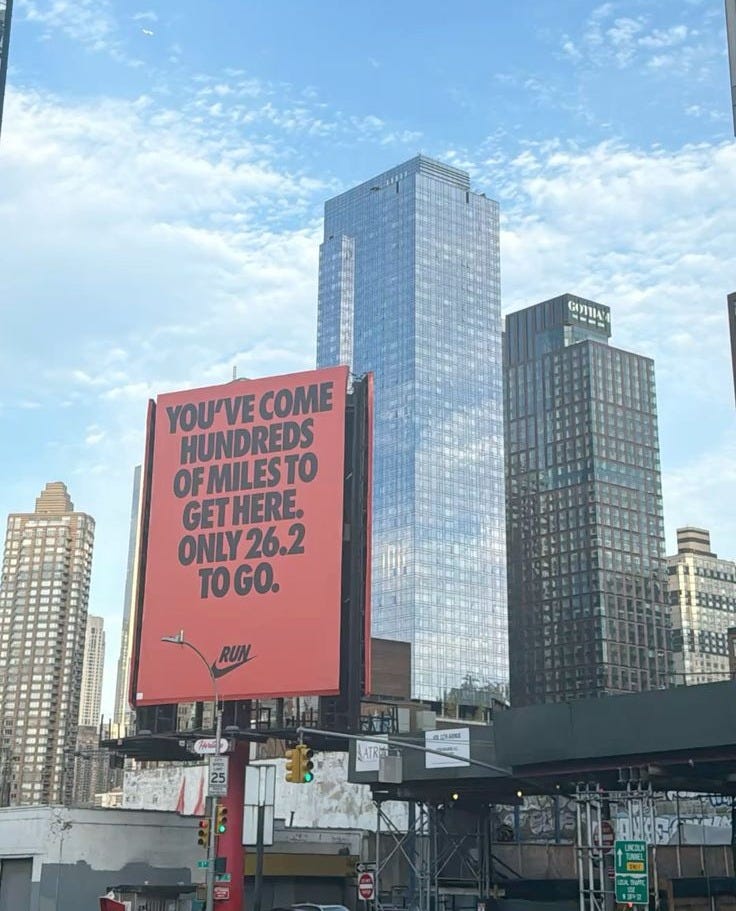
It’s, like, the greatest privilege in the world to have a pair of trainers and have found the mindset to want to take this on. I’ve never felt a high like the high of running well, for six hundred metres or sixteen miles. Girls play football now, and I hope they’re learning to fall over, to run faster than they thought they could, to be a teammate and a coach to one another and to themselves — as my favourite man, Coach Bennett, would say. Indeed, I credit every single bit of this understanding to him, the great man behind Nike Running Club, which has transformed what I know about who can be a runner and ultimately who can be an athlete. The answer is everyone. The app is exceptional, somewhat unbelievably it’s free, and it’s the greatest cheerleader you could possibly want. Through Nike Run Club, I’ve learnt about women runners I’d never heard of, and I think about their achievements when it gets rough. I’ve learnt to love watching long distance running on TV. I’ve learnt to love my sport, I guess. It’s been a long time coming for me but when it’s good, learning to get uncomfortable is the best lesson I’ve ever learnt, and when it’s bad, it’s even more important.
The marathon scares me a lot, even in the hard-won knowledge that you don’t die if you run twenty-six miles, even though the first guy did. I don’t know what’ll happen on the day but there are two things I’d like to do. I’d like to get faster at the end because it’s just about the thing that makes me feel strongest and it turns out I love feeling strong! And I’d like some of it to feel like flying. When people hear you’re running a marathon, a lot of them tell you they could never do that, and they don’t really like the answer ‘well if I can do it you can do it’ — by which I mean from one ordinary person to another, it’s pretty much mind over matter for several hundred miles of training, but it’s not exactly innate so if I can do it, you can do it! But I think what you start to recognise when you’ve heard it a few times is that they have no idea how it feels at its very best. I’m doing this because I know exactly how it feels when it’s going well, and it feels like flying.
*
I’m taking this unbelievable opportunity to run for a charity that I care about very much: Gatwick Detainees Welfare Group, who also run Refugee Tales. If you can, please do donate to my JustGiving page. If you can’t, please share it with anyone who might be interested in donating. It’s never lost on me that I’m choosing to get uncomfortable, after getting through my whole life so far without really having to. I run in the knowledge that so many people, including friends, have made risky and harrowing journeys of thousands and thousands of miles on foot, and never had a choice. I also can’t overstate how much any donations will make a difference to how much support GDWG can offer.
*
Please also send any great running songs in my direction (the vibe of the playlist, I am unashamed to say, is mainly Take That).
Or, like, a fraction of what I’ve been thinking about, in the free time when I’m not just thinking “I hate Hyde Park, I hate Hyde Park, I never want to see Hyde Park ever again”.
Although it’s not, of course, that they weren’t playing football. I learnt recently — in a TLS review, no less — about Lily Parr who played for the Dick, Kerr’s Ladies team during the first world war, and who is currently the only woman in the sport to have been commemorated in statue form, although no doubt not for much longer.